
Treatment
Spinal Decompression
Decompression gently unloads the spine to take pressure off a bulging or herniated disc and the nerves around it. We do it on a KDT Neural-Flex table, and it is non-surgical — you stay fully clothed, and a session runs about ten minutes.
Start here
Nine minutes on what decompression is for and how it works. Worth watching before your consultation — most of the questions people arrive with are answered in it.
Decompression therapy, explained
KDT’s patient education video: what the treatment does, who it suits, and what to expect from a course of it.
What decompression therapy does
A disc sits between two vertebrae and works as a shock absorber. When one bulges or herniates it can press on a nerve root, and the pain often turns up somewhere else entirely — down a leg, down an arm, or as a headache.
Decompression eases that pressure by slowly separating the vertebrae. The table applies traction, and positions you so the pull lands on the segment being treated rather than on your back in general. Taking load off the disc creates negative pressure inside it, which lets a bulge draw back in, and restores the flow of fluid, nutrients and oxygen the disc needs — a disc has no blood supply of its own and depends on that exchange to repair itself.
It is not a stretch you could do at home, and it is not the same as being pulled on by hand. The force, the angle and the hold are set by the machine and adjusted to you.
Two treatments, one word
"Decompression" covers two very different things. Both are trying to take pressure off a disc and the nerves around it; they go about it in completely different ways.
Non-surgical decompression is what we do here. You lie fully clothed on the table while it applies slow, controlled traction to separate the vertebrae and unload the disc. Nothing is cut, nothing is injected, and you drive yourself home.
Surgical decompression is an operation performed by a surgeon, under anesthetic, to physically remove what is pressing on the nerve. Depending on the problem that might be a diskectomy (removing disc material), a laminotomy (removing part of the bony arch to widen the canal), or a corpectomy (removing a vertebral body). It is used where there is a bony growth, a ruptured disc, or a neurological problem that will not wait.
The table we use
Ours is a KDT Neural-Flex, driven by an MTD 4000 traction unit — a device with FDA 510(k) clearance for traction and mobilization of skeletal structures and muscles.
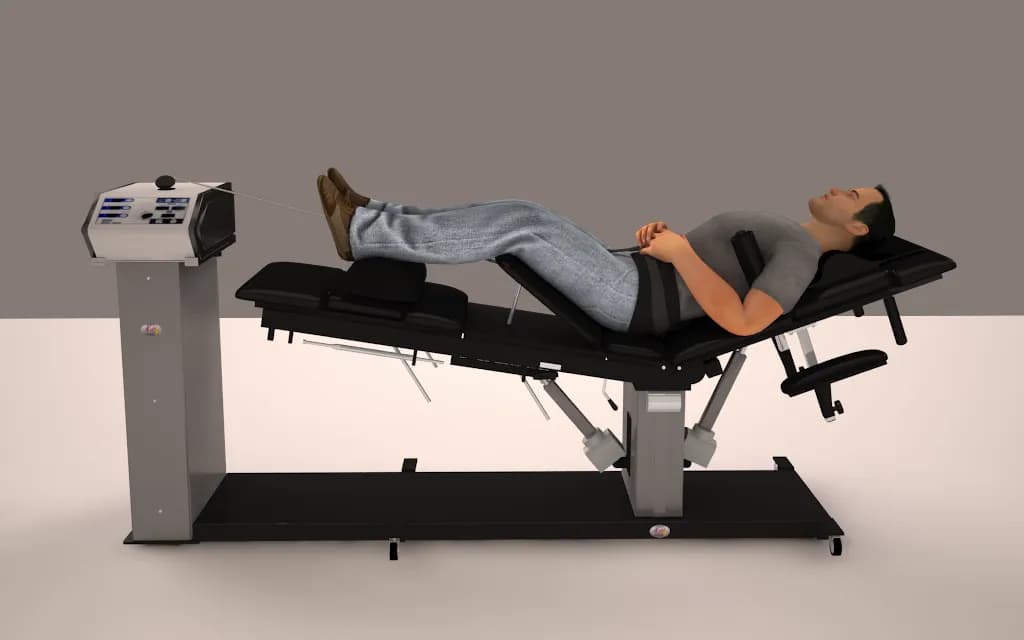
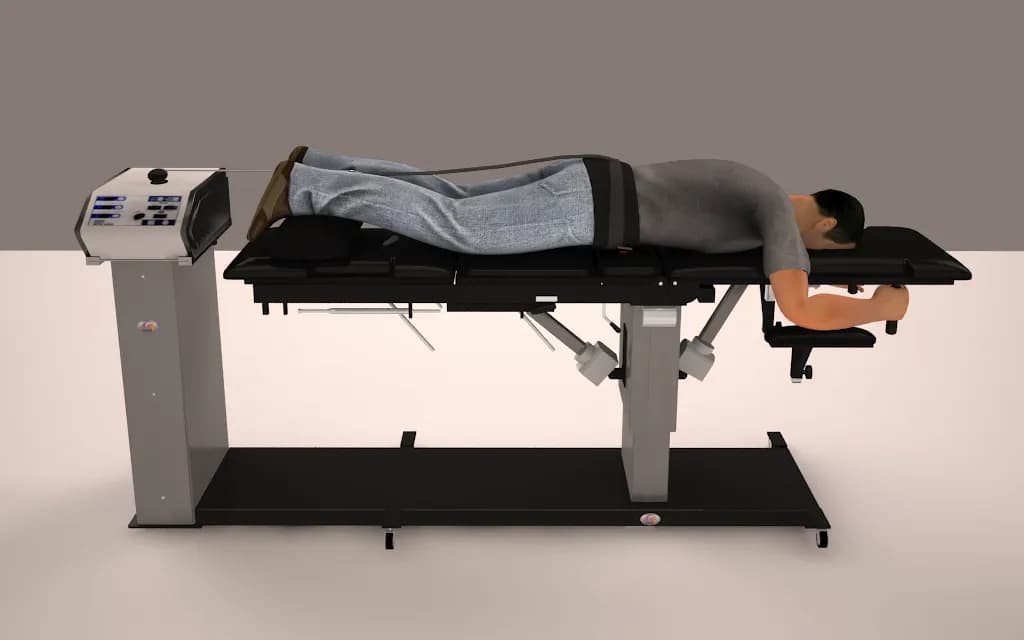
The table articulates, which is the part that matters clinically. It can flex, extend and side-bend while it pulls, so the pull can be aimed at a particular segment and a particular direction of movement. That is what allows the same table to treat a lower back face down, a lower back face up, and a neck.
You lie on it fully clothed. A harness goes around the pelvis or, for the neck, a cradle supports the head — nothing clamps, and you can stop the treatment at any point.
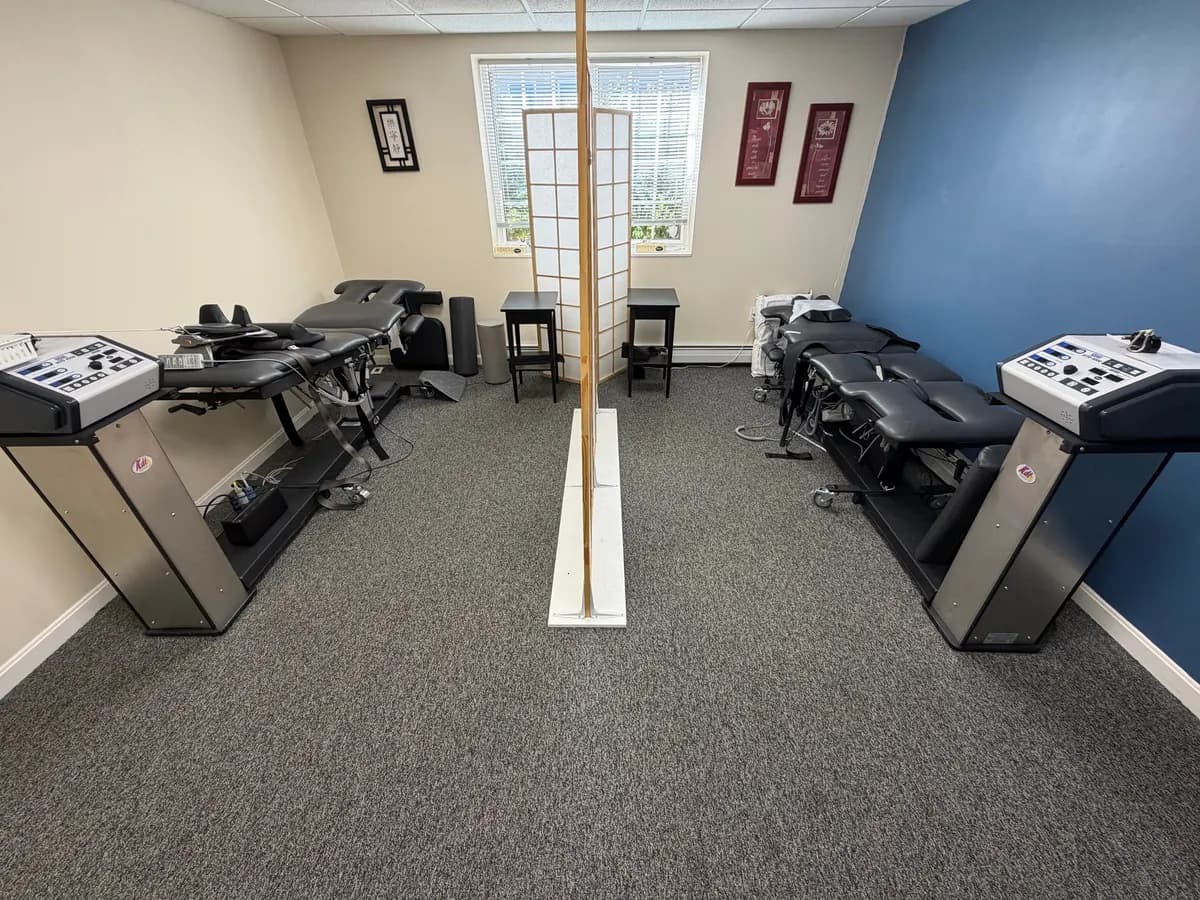
Our decompression room
Decompression has its own room at our Saco office, with two tables side by side and a screen between them. The traction unit stands at the foot of each table, where the chiropractor sets the pull for you.
It is a quiet room. You lie fully clothed for the eight to twelve minutes the treatment takes.
What the table actually does
Three short animations, one for each position we treat in. They show the movement from the outside and what is happening to the spine at the same time.
Lower back, face down
Prone flexion — used for most lumbar disc and nerve-root problems.
Lower back, face up
Supine — another route to the lumbar spine, chosen when lying face down is uncomfortable.
Neck
Cervical — for neck pain, arm pain and headaches coming from the neck.
What happens inside the disc
A physical disc model showing how unloading lets a bulge retract.
What we use it for
Decompression is aimed at pain coming from the disc, the facet joints or a compressed nerve root:
- Bulging, protruding and herniated discs
- Sciatica and radiating leg pain
- Neck pain and radiating arm pain
- Degenerative disc disease
- Spinal stenosis
- Facet syndrome and posterior facet pain
- Radiculopathy and spinal nerve root impingement
- Headaches originating in the neck
- Hypomobility — spinal segments that have stopped moving
- Some failed back surgery cases
Why try the non-surgical route first
For most disc and nerve-root pain, the conservative option is the one to exhaust first, and that is the ordinary standard of care, not a chiropractic opinion. Surgery carries anesthetic risk, a recovery period, and the possibility of not working: "failed back surgery syndrome" is a recognised enough outcome to have its own name.
Non-surgical decompression has neither the risk nor the downtime. What it costs you instead is time and persistence, which is the main reason people stop before finding out whether it would have worked.
None of which means surgery is the wrong answer. Sometimes it is plainly the right one, and you should expect us to say so.
What a session is like
Nothing about this is dramatic. Most people find it comfortable, and a fair number fall asleep.
Getting set up
You stay fully clothed. You lie face down or face up depending on what is being treated, and a harness is fitted around the pelvis — or a cradle supports your head, for the neck.
The pull
The table applies traction in a slow cycle, easing on and off rather than holding a constant pull. The force is set for you and can be changed at any point.
How long
Eight to twelve minutes of treatment. It is short enough that it usually fits inside an appointment you were coming in for anyway.
What often goes with it
Electrical muscle stimulation, ultrasound or therapeutic laser may be used in the same visit to settle the surrounding muscle and support healing.
Afterwards
Dr. Brent will usually give you specific exercises. Decompression takes pressure off the disc; the exercises build the stabilising muscle that keeps it off, and skipping them is the most common reason people lose ground between sessions.
How many sessions this takes
Decompression is a course, not a single treatment, and it is a longer course than most people expect. KDT’s own guidance is 20 to 30 sessions, three to four times a week — so roughly six to ten weeks, with the sessions close together at the start.
That is worth knowing before you begin rather than after. If three visits a week for two months is not something your schedule or your budget can take, say so at the consultation and Dr. Brent will tell you honestly whether a shorter course is worth starting or whether something else would serve you better.
Many people notice a change within the first several sessions. No two spines are the same, and the plan you are given will be built around your examination rather than off a standard schedule.
What the research shows, and what it does not
The study KDT cites most often is Gionis et al., in which 86% of 219 patients who completed a course reported their symptoms resolved immediately, and 84% were still pain-free 90 days later. Examination findings improved in 92% of them, and were still improved in 89% at 90 days.
We would rather you saw that in context. It is a manufacturer-cited study, decompression research as a whole is a mixed picture, and nobody can promise you a number. The honest position is that decompression helps a lot of people with disc and nerve-root pain, that it does not help everyone, and that the way to find out which group you are in is an examination rather than a brochure.
What we will commit to is telling you if it is not working. If a course is underway and nothing has shifted, that is a reason to re-examine the problem — not to sell you more sessions.
Insurance and cost
Decompression is a non-covered service with most insurance providers. Dr. Brent recommends treatment based on clinical exam findings and evidence, and we only recommend care for those who need it. Care plan options are explained, discussed and agreed upon with every patient before any care plan starts.
For services insurance does not cover, we participate in ChiroHealthUSA, a discount program for chiropractic patients. A one-year membership is $49 and covers you and your dependents, and it is honored at participating clinics nationwide.
Join ChiroHealthUSA online, read the patient brochure (PDF), or find other participating clinics. The discounts vary by service, so ask the front desk what yours would be.
ChiroHealthUSA is a discount medical plan, not insurance. It does not pay providers; members pay for their care and receive a discount on it from participating providers.
Questions about cost? Call the office on (207) 571-8028, or see our payment options.
Common questions
Does spinal decompression hurt?
It should not. The pull comes on and off gradually rather than being held, and most people describe it as a relieving stretch — enough of them fall asleep that it is worth mentioning. Tell us at any point how it feels and the force gets changed.
Do I have to undress?
No. Treatment is given fully clothed. Comfortable clothing you can lie in easily is all that is needed.
How long does a session take?
The decompression itself is eight to twelve minutes. Your first appointment is longer, because it includes the consultation and examination that decide whether decompression suits your problem at all.
How many sessions will I need?
KDT’s guidance is 20 to 30 sessions at three to four a week, so six to ten weeks. Dr. Brent will give you a plan after examining you. If that commitment does not fit your life, say so at the consultation rather than starting and stopping.
Is this surgery? Will I need medication?
Neither. Decompression is non-surgical and drug-free — no incision, no injection and no prescription. It is often used by people trying to avoid surgery, though it is not a guarantee of avoiding it.
What is the difference between non-surgical and surgical decompression?
Non-surgical decompression uses a traction table to separate the vertebrae and unload the disc, with no incision and no anesthetic. Surgical decompression is an operation that removes what is pressing on the nerve: disc material, or bone. Non-surgical is the kind we provide.
Should I try this before considering surgery?
For most disc and nerve-root pain, exhausting the conservative options first is the usual standard of care. There are exceptions (see when we will send you elsewhere for the symptoms that need urgent assessment), and Dr. Brent will tell you if yours is one.
What is the table you use?
A KDT Neural-Flex, driven by an MTD 4000 traction unit, which holds FDA 510(k) clearance for traction and mobilization of skeletal structures and muscles. It articulates while it pulls, which is what lets the same table treat the lower back face down, face up, and the neck.
Is it covered by insurance?
Decompression is a non-covered service with most insurance providers. Care plan options are explained and agreed with you before any care starts, and ChiroHealthUSA membership can reduce the cost — see Insurance and cost, or call (207) 571-8028.
Can I have it alongside other treatment?
Yes, and usually it is one part of a wider plan. Electrical stimulation, ultrasound or laser are often used in the same visit, and decompression sits alongside the rest of our therapies and techniques, including chiropractic adjustment.
Who should not have decompression?
It is not for everyone. Pregnancy, spinal fusion or surgical hardware, osteoporosis, a spinal fracture, a tumour, or an abdominal aortic aneurysm are all reasons to avoid it or to proceed differently. Tell us your full history at the consultation — that is what the examination is for, and Dr. Brent will refer you on if your condition needs care we do not provide.
How do I find out whether it would help me?
Book a consultation and examination. Call (207) 571-8028 or request an appointment online.
Related
Sciatica Care in Saco, ME
Sciatica is pain, numbness or tingling that starts in the lower back and travels down the leg. It happens…
Our Equipment
X-ray, spinal decompression and SoftWave therapy are all done in our Saco office, so most of your care…
Therapies & Techniques
Alongside chiropractic adjustment, our Saco, ME clinic uses a range of hands-on and equipment-based…
Ready to feel better?
If you’re dealing with stubborn back, hip or knee pain, start by checking your Pain & Mobility Score. It’s a quick way for our team to see what’s going on.